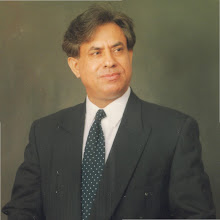
Rolling out the Red Carpet

I welcome you to my blog and hope that you will like the tour. Please leave your footmarks with comments and feedback. This will through and through enhance my knowledge and profundity of thought. Enjoy! Asif J. Mir
Showing posts with label good life. Show all posts

Thursday, December 25, 2008

Change, change

Why can't things just stay the same? I shouted angrily at the TV news anchor and threw a pillow at the screen and clicked it off with a snort. Suddenly a hissing noise arose from the corner of the room and a white, shimmering mist filled the air. I stood in shock as a tall, wrinkled old man emerged. He was my distant uncle, a grizzled fellow with a long flowing white beard and was saintly dressed from head to toe in white. His eyes twinkled with mischief as he flashed a gap-toothed grin. “Hi, I can take you to a place where people don't have to deal with change and things stay the same all the time.”

Before I could say a word, uncle asked me to simulate a graveyard and look at the polished gravestones stretched far out to the horizon. He said, “Here’s a place where things stay the same and people don't have to deal with change. Life is change,” the aged butch said with a chuckle as he leapt to the top of a headstone. “It's one of nature's mighty laws.” Eons ago, I had this conversation with this old chum.

After I started thinking about change I thought the single biggest change management failure of the 20th century was the old Soviet Union. With highly centralized planning, the politburo tried to tightly control the lives of an entire block of nations. There were to be few surprises and activities that weren't in the official plan. Bureaucratic organizations often try to do the same thing. So do many static, low growth individuals. We need to be on guard against our own rigid thinking and hardening of the attitudes.

The faster the world changes around us, the further behind we fall by just standing still. If the rate of external change exceeds our rate of internal growth, just as the day follows night, we will surely be changed. To the change-blind with stunted growth, it will happen suddenly and seemingly out of the blue.

Change forces choices. If we’re on the grow, we’re embracing many changes and finding the positive in them. It's all in where we chose to put our focus. Even change that hits us in the side of the head as a major crisis can be full of growth opportunities — if we choose to look for them.

We don't always get to choose the changes that come into our lives. But we do get to choose how to respond. Crisis can be a danger that weakens or destroys us. Or crisis can be a growth opportunity. The choice is ours. Which ever we chose — we're right about that crisis. We make it our reality.

Change is life. Successfully dealing with change means choosing to continuously grow and develop. Failing to grow is failing to live. Life is the sum result of all the choices we make, both consciously and unconsciously. If we can control the process of choosing, we can take control of all aspects of our life. We can find the freedom that comes from being in charge of ourselves.

Accepting responsibility for choices starts with understanding where our choices lie. There is a long list of things we can't control, but may have a major impact on us as individuals or as clusters. These include economic and political trends, technological changes, shifts in consumer preferences and market trends, as well as catastrophes wrought by human beings (war, terrorism and etc) and so-called Acts of God, such as earthquakes.

The best approach to dealing with things that cannot be changed is to accept them. When the doo-doo starts to pile deep, we ought not just sit there and complain; we ought to grab a shovel. We may not choose what happens to us, but we do choose how to respond – or not.

Choosing to make changes is hard. It's so much easier to blame everyone else for our problems and to use this as an excuse for doing nothing. We must not give away our power to choose. In his bestseller, The Road Less Traveled, Scott Peck writes, “Whenever we seek to avoid the responsibility for our own behavior, we do so by attempting to give that responsibility to some other individual or organization or entity. But this means we then give away our power to that entity, be it fate or society or the government or the corporation or our spouse. It is for this reason that Erich Fromm so aptly titled his study of Nazism and authoritarianism, Escape from Freedom. In attempting to avoid the pain of responsibility, millions and even billions daily attempt to escape from freedom.”

It takes real courage to accept full responsibility for our choices – especially for our attitude and outlook. This is the beginning and ultimately most difficult act of leadership.

We must engage ourselves into lively debates about those things over which we have the power to act. We can easily classify them as belonging to three categories: No Control; Direct Control; and Influence. It's rarely black and white. For example, we often underestimate the influence we might have in our functions – or in the world at large. Each time a man stands up for an idea, or acts to improve the lot of others, or strikes out against injustice, he sends forth a tiny ripple of hope, and crossing each other from a million different centers of energy and daring, those ripples build a current that can sweep down the mightiest walls of oppression and resistance.

We're either part of the problem or part of the solution. There is no neutral ground. Strong folks make the choice to be part of the solution and get on with it – no matter how small their ripples of change may be. (www.asifjmir.com)

Sunday, November 23, 2008

Emphasizing Well-being

In recent years, psychologists studying measures of life satisfaction have largely confirmed the old adage that money can’t buy happiness—at least not for people who are already affluent.

A nation is successful not when it’s rich but when its people are happy. If you are very poor, there is no doubt that greater income can improve your life. But once the basic needs are secured, well-being does not necessarily correlate with wealth. The social and psychological needs of human beings also shape our cultures, and help to determine whether our civilization is sustainable or not. Good life is redefining prosperity to emphasize a higher quality of life, rather than the mere accumulation of goods.

The Prime Minister is busy sketching up plans for making continuing increases in gross domestic product (GDP) as a chief priority of domestic policy, under the assumption that wealth secured is well-being delivered.

Whether due to curbs on hundi business as a post-9/11 scenario or owing to connoisseur planning, foreign exchange reserves (FER) of Pakistan touched highest levels ever in the previous government. With increased GDP and FERs the number of suicidal deaths also grew larger when poverty ridden people take their lives. This situation demonstrates that some link was broken somewhere. And that’s about social moorings and calls for a shift in paradigm.

The government must focus on delivering what people most desire. Indeed, a new understanding of good life can be built not around wealth but around well-being: having basic survival needs met, along with freedom, health, security, and satisfying social relations. Consumption would still be important, to be sure, but only to the extent that it boosts quality of life.

Pakistani society if focuses on well-being will involve more interaction with family, friends, and neighbors, a more direct experience of nature, and more attention to finding fulfillment and creative expression than in accumulating goods. It should emphasize lifestyles that avoid abusing our own health, other people, or the natural world. In short, it will yield a deeper sense of satisfaction with life than many people report experiencing today.

What provides for a satisfying life? The disconnection between money and happiness in wealthy countries is perhaps most clearly illustrated when growth in income is plotted against levels of happiness. In the United States, for example, the average person’s income more than doubled between 1957 and 2002, yet the share of people reporting themselves to be very happy over that period remained static.

Happiness is best predicted by the breadth and depth of one’s social connections. People who are socially connected tend to be healthier—often significantly so. More than a dozen long-term studies in Japan, Scandinavia, and the United States show that the chances of dying in a given year, no matter the cause, is two to five times greater for people who are isolated than for socially connected people.

International development professionals also now acknowledge that strong social ties are a major contributor to a country’s development. The World Bank, for instance, sees social connectedness as a form of capital—an asset that yields a stream of benefits useful for development.

Creating a higher quality of life requires us to help create new political, physical, and cultural infrastructures of well-being. Pakistan has no such infrastructure and is thus ranked 167 out of 180 countries in Well-being Index. Sri Lanka ranks 49 and Bangladesh 131. Interestingly, Nigeria ranks 133, a position better than Pakistan.

Year after year, the Human Development Index report shows Pakistan lagging behind the rest of the regional countries. Our investment in realizing the human potential remains the lowest in South Asia. The HDI report lists a shocking situation of the poor quality of life in Pakistan.

The standard tool used to measure societal health, GDP, is much too narrow to serve as a yardstick of well-being because it sums all economic transactions, regardless of their contribution to quality of life. It also ignores entire swaths of non-market activity that contribute to individual and society well-being.

A well-being society would offer consumers a sufficient range of genuine choices rather than a large array of virtually identical products. Businesses would be encouraged through economic incentives to deliver what consumers really seek—reliable transportation, not necessarily a car; or strong neighborhood relationships in lieu of a large house with a big yard. Choice would be redefined to mean options for increasing quality of life rather than selections among individual products or services.

If focused on well-being Pakistani society would ensure that everyone in it has access to healthy food, clean water and sanitation, education, health care, and physical security. It is virtually impossible to imagine a society of well-being that does not provide for people’s basic needs.

Making the transition to a society of well-being is a challenge to the new premier given people’s habit of placing consumption at the apex of societal values. All the same, any move in this direction starts out with two strong advantages. First, the human family today has a base of knowledge, technology that can be invested in well-being rather than in continued material accumulation for its own sake. A second advantage is simple but powerful: for many people, a life of well-being is preferred to a life of high consumption.

By nurturing relationships, facilitating healthy choices, learning to live in harmony with nature, and tending to the basic needs of all, the PPP Government will leave its indelible footprints in history if it shifts from an emphasis on consumption to an emphasis on well-being. This could be an apposite response to the growing number of suicidal deaths due to poverty, and to be his great achievement in the twenty-first century.