There will be absolutely changed conditions under which public managers will operate in the future, some of the areas of knowledge, skills, and attitudes that they will be required to possess, and some of the pathways public managers might explore in order to move toward the future.
There will be an extraordinary explosion of new knowledge and technological innovations, especially in the areas of information sciences, genetics, materials, instrumentation, automation, and space. Our public managers will wade into an age of extraordinary technological change and have to accommodate themselves and the institutions to dramatically different bodies of knowledge and technological innovations.
They will not only have to cope with and employ their expanded knowledge and technological capacity, they will have to learn to use this knowledge and technological capacity for the benefit of society. In the technological world of the future, there will be even greater temptations for them to be captured by technology, to fall prey to “technological imperative,” and to allow rational technical interests to supercede human concerns and those of values. Finding ways of employing advanced technologies so as to enhance rather than restrict their capacity for leadership, creativity, and personal responsibility will be a serious challenge.
In the future, knowledge and information will prevail. And if information is power, then those who have information will indeed have power. But who will have information? Information will be increasingly centralized and controlled and marketed through traditional economic and political processes. It will be widely distributed throughout society, so that increasing rather than decreasing numbers of people will have information and in turn have power. Such a possibility will lead to “the twilight of hierarchy,” to be inevitable.
Combining these issues, we can safely predict that the knowledge or information that our public managers will be able to access will be tremendous, to the point that the quantity of information will no longer be the most important issue. Rather the key question will be how to organize this information for human purposes. This means that public administration will have to learn to organize information in a fashion that will facilitate the pursuit of important public purposes. The great challenge will be to organize information so that we can enhance the process of democratic decision-making, of consensus building, and of dialogue and deliberation.
There’s no question that we will have the capacity to organize information for dramatic new public purposes, to restructure our structures of governance in dramatic ways. But what will our choices be? Imagine a computer in Islamabad that could reach out into every home, so that on any occasion that a major policy decision was required, an appropriate message could go out to all the citizens and their answers could guide public policy - a process that would approximate pure democracy.
The globalization of society is obvious today, though in twenty-five years or so, we may experience trans-globalization or beyond, as the frontiers of the oceans and space are extended even further. Already we are thinking more in global terms. However, our managers are still thinking in terms of traditional institutions operating in a new global context. They are not yet asking how they reconfigure businesses and governments so as to carry out a global vision. How do they encourage businesses and governments to assume global responsibilities rather than those defined in terms of one’s own self interest? For example, how can Pakistan move toward sustainable development and environmental justice on a global basis?
One obvious casualty of the global age may be the nation-state, replaced not necessarily by a new global or interplanetary federation but possibly by new forms of governance far beyond those we can imagine today.
In future our public administration should know the importance of “responsibilities” rather than “functions” of government. While a large part of the current worldwide debate over privatization or outsourcing speaks to the question of which “functions” belong where, the new debate will necessarily focus on public responsibilities and speak in a language of ethics, citizenship and the public interest.
In reinvented government or the new public management, customers shall replace citizens - or, to put it differently, the integrative role of citizenship has been reduced to the narrow self-interest of customership - in government as in business.
Indeed, we think the job of all public managers will increasingly be more than directing or managing our public organizations. It will be not merely “steering” or “rowing” but “building the boat.” The new public manager will construct networks of varied interests that can work effectively to solve public problems. In doing so, it will be the job of the public administrator to promote pluralism, to create opportunities for constructive dissent, to preserve that which is distinctive about individuals and groups, and to provide an opportunity for diverse groups to share in establishing future directions for the community. The administrator will play a substantial role in diminishing polarization, teaching diversity and respect, building coalitions, resolving disputes, negotiating and mediating. The work of the top public managers will thus be - to build community.
There are two broad areas that public managers will need to explore in order to fashion a response to the trends. These emerging trends will turn public management both “inside-out” and “upside-down.” Public management will be turned “inside-out” as the largely internal focus of management in the past is replaced by an external focus, specifically a focus on citizens and citizenship. Public management will be turned “upside-down” as the traditional top-down orientation of the field is replaced - not necessarily by a bottom-up approach, but by a system of shared leadership.
In the past public administration has been largely focused on what happens within the public bureaucracy. The future will require that it dramatically refocus its attention on the world outside, particularly the world of citizens and citizenship. Asif J. Mir, Organizational Transformation


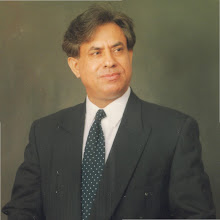

A Distinct Candle is Extinguished!
-
“I am announcing, with a heavy heart, the sudden demise of my beloved
father, Asif Javed Mir, due to heart failure on 18th December,2013. I
request to ever...
12 years ago

 Posts
Posts


