Scientist, by intention or not, is the most important catalytic change agent of our time. We all recognize that much of the present is the future that was created by scientific researchers of decades past. We can safely forecast that scientists will change our future.
No scientist alone can propose the whole science agenda for the 21st Century. It is however clear that many scientists can agree on some overarching goals that serve the future and that give us pause for reflection as they expand the frontiers of knowledge and uniquely see their own opportunity for discovery.
What scientists achieve is the understanding about the way nature really works. They use powerful methods of defining and solving problems. They use the method of multiple working hypotheses to ferret out the truth about how nature is and the way it operates. Scientists have the exhilarating opportunity and experience of being able to routinely walk each day where no footprints have ever existed before. They extend that paradigm to additional utility to not only enlarge our understanding and build our knowledge but to provide amenity in the form of new technology.
From Galileo to the cellular user in Gujranwala, scientists make social change occur abruptly, often inadvertently. As new knowledge is discovered, and foundational research impacts others around us, they create and alter the future and how everyone around us perceives it. Their research regularly leads to changes unimagined by our institutions struggling to adjust to them.
The highest priority of all science and social, economic and political institutions on this planet is to develop and establish a morally acceptable, politically stable and economically feasible decrease in the world human population of 1 billion persons during the 21st Century and to continue that decrease by another 1 billion during each of the succeeding 2 centuries. This is a daunting challenge, but one from which we cannot turn aside. All our institutions are driven by growth. Opposition to this population decrease will develop from the world capitalist systems whose only mantra is growth. The immense power wielded by that economic mantra and its leaders may draw the battle lines for the soul of the 21st Century.
Sustainable aquatic and land based agricultural production systems, sustainable energy production systems, sustainable industrial and post industrial production systems, sustainable habitation systems and others are areas of major needs for research that ultimately establishes a sustainable world.
The 21st Century will require our population to think for a living. Thinking skills have become the most important skills for the workplace. The employers and nations of the future will rise and fall in their competitive effectiveness based on their skill as learning organizations and the rate limiting factors for their future success will be the rate of learning of the populations engaged in productive work.
Our education systems must be understood as whole systems and changed even revolutionized to accept and optimize what we learn about learning in the first five years of life, our teaching adapted to the neurobiology of learning, our curriculum redesigned around creative problem solving as its core curriculum, ensuring lifelong learning becomes a societal norm, our cyber schools and virtual universities designed around how we learn and for no other primary convenience.
Healthier lives is the third overarching goal that seems to be a consensus among leaders of all the scientific disciplines as important for the 21st Century to make great strides. Since infectious diseases are once again worldwide scourge, we must provide worldwide treatment and preventive medicine successfully.
Ideas not yet thought of, will become multibillion-dollar enterprises in the 21st Century. This requires us to foster entrepreneurial education to ensure there is a sufficient population of business adventurers to make certain the public sees ongoing benefits flowing from it that they can understand, and new jobs are a benefit that is readily understood.
National and world security has been the most important drivers of the old social contract with science. We have still the need to defend the free from the rogues who have the power to take away freedom. As we see that military superiority is no longer the driver for the scientific future, scientists should reassess their need to be involved in its destructive exterminations.
Scientists can do so much more for the future of the world and its people and environment with all the challenges. Their role should be to support the very strong leadership and creative problem solving needed by the military and political institutions and durable new institutions that would lead to highly certain world stability. The rise of the concept of the nation-state requires it to defend its borders and culture. Evolving thinking into newer concepts that enhance cooperation more than pathologic competition may become worthwhile at some point in 21st Century.
Scientists can do everything to provide for a world of well-fed, healthier and fewer people, to provide that populations are economically secure and stable, to provide for our great-grandchildren an environment with as durable a future as our great-grandparents received when they were born, and to ensure the lifelong learning that provides all the self-actualization and inner peace we can want.
The role of scientists should be to lead the political system, not follow it, and do this via a long range vision that they develop, conceive and believe, so that it becomes compelling to the public and future resource allocators.
Scientists’ own future depends on effective development of appreciation for science by the political decision making institutions and science illiterate general population. They should not leave it to others to do what needs to be done. It is their future. It is their obligation. Their role has never been of watching the future happen. They are the change agents of future and they can make it happen. Asif J. Mir, Organizational Transformation


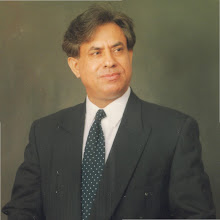

A Distinct Candle is Extinguished!
-
“I am announcing, with a heavy heart, the sudden demise of my beloved
father, Asif Javed Mir, due to heart failure on 18th December,2013. I
request to ever...
12 years ago

 Posts
Posts


