We have already entered into the 21st century with the nefarious bag and baggage containing nauseating political environment and the stomach-churning poverty. While we read about great strides the Asian Tigers are making in economic development and prosperity, Pakistan continues to lurch around with moral degeneration and lust for guzzling the vitals of nationhood. As we hear that China and India are going to emerge as economic giants in this century, the up-and-coming trends illustrate the murky future of Pakistan.
Having toured more than forty countries, I can rightfully claim to be a globe trotter. And I have traveled to China so repeatedly that I should be eligible to call it my second home. In one of the trips with wife, an incident made me embarrassed quite a bit. The story runs thus: While in Shanghai, before having a nap my wife cursorily glanced a tourism magazine provided by the hotel where we were staying. A story attracted her attention, which was about Lahore that happened to be our birthplace and the heart of Pakistan. Although it did not fall short of truth in any way, reading in a foreign magazine about our eroding national character really saddened us. Indeed it was morally wrong my wife ripped off the article penned by Josephine Bow that unfortunately reflected the dominating way of life in Pakistan. I am sharing some of its excerpts as follows:
“ . . . . Languishing on the sidelines instead of jostling in the mainstream, Lahore is a gracious but frustrating relic of an era long gone. The economic boom and accompanying quickening of pace that has swept over Asia—from Delhi to Seoul—like a giant tidal wave during the past two decades seems to have stopped short at the gates of Pakistan.
Beset by corrupt politicians and businessmen—often one and the same—government policies seesaw wildly depending upon which interest group squawks the loudest. Recent years have seen revolving door of governments, resulting in a sense of helplessness and inertia at the individual level. The oft-heard lament is what can one man do against the system?
Lahore looks as if it’s becoming a sleepy town. Don’t expect to get anything done in a hurry. For one thing, nobody of responsibility gets to their offices before 11 AM and secretaries never know where their bosses are. Punctuality is not a widespread practice—arriving within an hour either side of the appointed time seems to be considered acceptable.
For local businessmen, the inability of government to formulate stable policies has generated an ‘every man for himself and the rest be damned’ attitude. Young professionals educated abroad despair that their hard-earned degrees and legitimate career choices are looked upon with disdain. Instead it’s those who can make money in the quickest and often most illegal manner who are admired.
What is probably more difficult to adjust is the lack of a developed work ethic or observance of basic business practices. Here everyone’s a director or manager giving orders, but there’s little follow-up. Be prepared to insist if you want to get anything done.
In the sluggishness to embrace the global economy, ironically even the country’s strengths can become weaknesses. Take, for example, the fact that Pakistan is self-sufficient in cotton. Lahore, in the heart of the rich Punjab cotton-growing region, is considered by many to be the country’s future textile capital. Yet despite occasional pockets of progress, overall export growth in value-added items has been disappointing.
Bangladesh, on the other hand, registered tremendous growth in garment exports. The analysis is that, with its weak local raw-materials base, manufacturers were exposed early to overseas business practices as they learned to deal with fabric suppliers in Korea, Taiwan and Hong Kong. Rich from the earnings and experience amassed over the past 15 years, large Bangladeshi garment groups are now opening carefully thought-out textile units.
As Pakistan enters yet another period of political uncertainty, it’s difficult to say whether conditions will improve in the near future.
Lahoreans are considered to be great talkers. Indeed residents of nearby Sialkot, the world’s manufacturing capital for soccer balls and martial-arts uniforms, explain their city became globally competitive because it hosts no other extracurricular activities—not the case with Lahore, which boasts theatre, art galleries and other cultural pastimes.
Horse drawn carts, motorcycles, trucks and every other imaginable form of vehicular transport make their way in a confused shambles on often unpaved and potholed roads—a nightmare during the rainy season.
Driving is very much local style and no one respects lanes or direction, for that matter. Watch out for three-wheel scooters crossing lane dividers and careening wildly in the wrong direction. . . . . ”
Baba Bulleh Shah has truthfully said: truth inflames. Initially the critique about our national attitude caused us noticeable irritation. Just the same, when we recuperated rationalism we recognized that the writer put across the harsh facts quite rightly.
Past civilizations, nations and peoples perished due to lack of purpose, nationhood and when self-centered attitude dominated the national purpose. Today Pakistan also stands face-to-face with such erosion. The value system is under serious attack—not by someone from outside, but internally at individual level. This is simply contrary to norms of freedom.
Pakistan must learn from past and future. It must change its ways to shun disaster. It must recreate itself. The confronting challenge calls for a leadership capable of eliciting the best out of the people. Traditional top down notions of leadership are giving way to concepts of attitudinal reforms, social transformation, and collective restructuring. Pakistani society desperately needs to look into the future and see the nation not as it is … but as it can become. A choice nevertheless lies ahead: either to change or become a French song once sung by swan. Asif J. Mir, Organizational Transformation


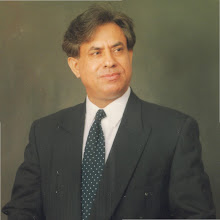

A Distinct Candle is Extinguished!
-
“I am announcing, with a heavy heart, the sudden demise of my beloved
father, Asif Javed Mir, due to heart failure on 18th December,2013. I
request to ever...
12 years ago

 Posts
Posts


