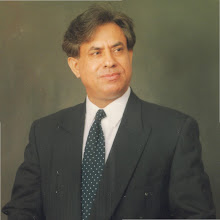
Rolling out the Red Carpet

I welcome you to my blog and hope that you will like the tour. Please leave your footmarks with comments and feedback. This will through and through enhance my knowledge and profundity of thought. Enjoy! Asif J. Mir
Showing posts with label structures. Show all posts

Wednesday, February 25, 2009

Globalization

The world of today is barely recognizable when compared with the world, which faced our parents when Pakistan was created. And it is a radically different world to the one that challenged our grandparents' generation when they were young adults. Of course, change has always been with us, but the difference today is that the pace of global change is quickening.

Globalization is shaping and reshaping today's world and the world of tomorrow - your world - in extraordinary and far-reaching ways.

The defining feature of globalization is that firms, social networks, political structures and information flows are increasingly being organized along trans-boundary lines with the emphasis on the exercise being undertaken rather than on traditional boundaries. What globalization is teaching us then is that the greatest security we have comes from excellence, innovation and adaptability. It comes from the dynamic ability to deploy and expand our skills and talents as individuals and societies. It comes from knowing that we have the strength and resources to meet any challenges that come our way - not always by ourselves, but often with the help and support of our friends and neighbors.

The real choice for most other people in the world is the extent to which we participate in a wealth-generating process of global proportions, and harness its potential, not whether we participate. That is why the future will belong to those who embrace globalization and are willing to prepare for it. And education is the key to preparing for our shared, global future.

The world of tomorrow will require people with a genuine depth and breadth of talents - not just the formal skills found in the engineering, scientific, economic, legal, medical or other professions - vital though they are - but many other skills as well. The global information and telecommunications revolution is an excellent example of what I am talking about.

New forms of communications technology, emerging by the month, are ensuring that no corner of the world will be untouched by globalization. The notion of a purely domestic market is becoming obsolete with the spreading use of the Internet. Once a product or service is available on the Internet, it can be sold to the world at large.

Recent estimates suggest that the value of goods and services transacted on the Internet will grow from its current value. And before too long, it will be possible to access the Internet not just in English but in the user's own language.

The fast growing services sector is another dynamic part of the global economy, which offers unique challenges and opportunities for tomorrow's professionals. To succeed in this demanding sector, you will need to understand and work in a range of different cultures, languages and legal and financial systems. You will need to think and act in region-wide and global terms.

That is why tomorrow's world will require people who are willing to embrace the world around them and all that it offers. It will require people who can shape global and regional forces to the advantage of their societies and enterprises, and not be cowered and defeated by them.

Above all, the 21st century is the century of the knowledge worker. Universities are sources of the new knowledge, which will be needed by tomorrow's leaders, and are key repositories of the wisdom and insight we have garnered to date.

If the process of global enrichment is to continue unabated, universities and other applied institutions will need to drive the development of global knowledge workers. Pakistan needs to make a strong policy commitment to promoting education, not just for Pakistanis but also for people from throughout the Asia, Africa and beyond, in preparation for the new era.

I know that the new skills and insights people have gained will help them build their own futures with pride, and the futures of our countries with equal pride. But the vital contribution people make to the success and stability of Pakistan will do more than enhance the lives of their friends and families. It will lay the foundations for the well-being and security of people throughout the Asia.

I believe that Pakistan needs to do something to recognize this important link between knowledge and the development of better and more effective relations between countries. We need to harness the intellectual `horse power' of the Pakistan’s university system. We need to place this unique educational asset in the service of our national interests more systematically and productively.

Pakistan has a proud history of educating people. Today we are confronted with the challenge of preparing the worthy custodians of that tradition.

According to UNESCO's global estimate, 1.35 million tertiary students study outside their home countries. And Pakistan hosts a number not worth considering of these students on a per capita basis than other Asian countries. This is a clear indication not just of the quality of our institutions but of the little primacy we attach to education and particularly our national identity established by the West after the 9/11. Lucklessly this identity has been tarnished mostly by the power that considers Pakistan as the major ally in its war against terrorism. Pakistan must do something to scratch out this image.

Pakistan has great institutions with remarkable traditions of excellence in higher learning and personal development. Nobel Laureate Dr Abdul Salam symbolizes this tradition.

A successful global future requires a global education, and it requires deep respect for the cultures, values and experiences of others. It also requires advanced studies in reading the futures, upcoming trends and above all corporate and administrative creativity. They need to tailor courses for our future policy planners to study creativity and innovation.

Being a developing country Pakistan’s industry is emerging and in a buildup stage. Hence informed decision-making in investment is significantly needed. It should use commercial intelligence as a tool to have a nodding acquaintance with future trends and sneak out of stereotyped and monotonous thinking. Asif J. Mir, Organizational Transformation

Wednesday, January 14, 2009

"We the people . . . . ."

From the lost Constitution of 1973 to its current structure, all incumbents have been cutting holes with amendments to fortify their power. No effort has ever been made to consolidate the power of people. Never has there been any attempt to include the parts that protect consumer rights. Thus and so, the Constitution of Pakistan does not guard the consumer rights of the citizens of Pakistan. Implicitly, first come the rights of the citizens, and then comes the Constitution. If a constitution contains adequate procedures to protect rights, it can be legitimate even if it was not consented to by everyone; and one that lacks adequate procedures to protect human rights is unfair even if it was consented to by a majority.

Future is on our head with the concept of globalization that is changing the focus of governance. Instead of territory, human rights are now getting significance. And consumer rights happen to be the component of larger human rights program.

Consumer means people. By barely defining consumers as customers, we bar millions of citizens who due to lacking resources can’t buy. So consumers are citizens. Moreover, everybody has to consume to survive—consumption is a natural process for human survival. Thus, everyone is a consumer by default.

Consumers are the largest economic group in any country’s economy, affecting and affected by almost every public and private economic decision. But they are also the only important group that is not effectively organized, whose views are not heard. Therefore, the Government, the highest spokesman for all people, has a special obligation to the consumer’s needs.

The consumer rights have a universal significance as they symbolize the aspirations of the poor and disadvantaged. On this basis, the United Nations, in April 1985, adopted its Guidelines for Consumer Protection. They include: 1) the protection of consumers from hazards to their health and safety; 2) the promotion and protection of the economic interests of consumers; 3) access of consumers to adequate information to enable them to make informed choices according to individual wishes and needs; 4) consumer education on the environmental, social and economic impacts of consumer choice; 5) availability of effective consumer redress; and 6) freedom to form consumer and other relevant groups and the opportunity to present their views in decision-making processes affecting them.

No legislator, no political scientist, no intellectual, and no so-called constitutional expert ever provided a new, realistic and philosophically rigorous theory of constitutional legitimacy that justifies both translating the Constitution according to the needs of people and, where that need is vague or open-ended, construing it so as to better protect the rights of the people. Consequently, even the general principles defined by the UN could not be realized.

The consumer protection issues are seldom included in the agendas of utility service providers, most of which are in public sector. Consequently, the rights of poor Pakistanis are being trampled even by public sector organizations like WAPDA, Sui Gas, and PTCL, to mention a few. Little attention is given to consumer protection policies, and consumer friendly market structures, incentive regulation, tariff regimes, deregulation and competition.

Consumer issues can be chronicled even before partition under the colonial rule that established monopoly regimes, when consumers had no voice at all. Same structure was adopted after independence and it continues on and on disregarding the advent of competition, which has given rise to greater concern about consumer welfare. Hence the consumers in Pakistan today feel that they remain to be excluded from the decision-making process. They believe that they are still far off from the regulatory process that provides them no opportunity to influence or even overturn critical decisions. And so consumer perceptions and opinions about the marketplace scenario are depressing.

In Pakistan lack of choice among alternative service providers due to a single or dominant operator is making consumers vulnerable. They have no right, whatsoever, for intervention where dominant operators are protected by the government, where there is no quality of service performance requirements and where dominant operators are authorized to set tariffs without rationale and beyond reach of the majority.

An informed consumer is an empowered consumer. Regulators should make every effort to empower consumers. Specific educational mass-media campaigns are needed to educate consumers about their rights. School textbooks are another useful but neglected channel to educate consumers about their rights. Education is a powerful, albeit, long-term action to shape people’s attitudes about enforcing their rights as consumers.

Activities that regulators should consider in setting up the consumer agenda include: establishing customer services, creating mass awareness of consumer rights, enforcing those rights, creating nationwide offices to address consumer issues and offering dispute resolution systems.

India is getting a global reputation for the rapid development of its consumer movement. Today that is perhaps the only country in the world, which has exclusive courts for consumer redressal of grievances that too within 90 to 150 days. One of the greatest achievements of the Indian consumer movement is the enactment of the dynamic consumer law in 1986: COPRA. Coming 39 years after Independence, it has acknowledged the rampant consumer abuses, including those of the government owned public utilities like telephones, transport, power etc.

Pakistan does not have a cohesive national consumer policy. Neither it has a national consumer protection law. The Federal List in the Constitution does not include the issue of consumer protection. Perceptibly, the provinces also don’t have consumer protection laws. The federal capital promulgated a consumer protection law in 1995 but was never implemented. Since the State has not provided any protection mechanism that consumers could use to protect them, hence they feel very helpless. Controversial amendments or litigious issues aside, our legislators ought to think about people and at least give a national consumer protection law. (Click Asif J. Mir to view his professional profile)

Monday, December 15, 2008

Bureaucracy and Change

While new technologies, new paradigms of governance, and new management structures are being put forward the bureaucracy of Pakistan is driving into the future using only rear view mirror.

At the beginning of the twenty-first century, change is everywhere. The reality of yesterday proves wrong today, and nobody really knows what will be the truth tomorrow. Social, political and economic change has come fast like a small boat dancing on the waves. People feel that they do not have any influence In the mainstream of this environmental milieu, people of Pakistan are detesting bureaucracy, from inside and outside: red tape, punctiliousness, delay, extra social overhead, unresponsive monopoly of authority; professional deficiency; and obsolete policy planning.

Below the politically appointed ministers is the civil service. Efforts to reform and modernize the traditional civil service were never made to improve the professional competencies of senior civil servants. The prevailing unanswered issues demonstrate that the training acquired by government officers at NIPA or Pakistan Administrative Staff College is ineffective, redundant and unproductive. Thus the need to reform has fallen behind its expansion in size and functions, making Pakistan an over-administered society. All governments pared back the state's control over the economy but failed to restrain the growth of the state bureaucracy and allowed its standards and efficiency to decline.

Our bureaucracy tries to fulfill government strategies, which had been formulated years ago, under totally different baseline conditions. Service quality is often not more than an empty phrase. The competence of our bureaucracy can be measured from the fact that it could not workout a policy for urbanization. Consequently, luckless consumers continue to be treated worse than one-time colonial rulers. Everyone has tales of dealing with bureaucrats who seem utterly unsympathetic to real problems and explain why the rules don’t allow a solution.

Our bureaucracy has utterly failed in using creativity in policy making. Thus, it could not generate new ideas for issues like unemployment, economic development and poverty alleviation. Management creativity is about using simple techniques to find innovative solutions to prevailing problems. And creativity, which is extraterrestrial skill to our bureaucracy, isn't just nice-to-have. In a fast change, furious public administration, it's a matter of survival.

Change happens. And while we can't control much of the world changing around us, we should know how to respond. We can choose to anticipate and embrace changes or resist them. Resisting change is like trying to push water upstream. Our bureaucracy is recognized as the one that resists change. It's much harder for bureaucracy to admit to its own change resistance.

Pakistan’s bureaucracy defends the status quo long past the time when the quo has lost its status. (Status Quo Ante Erat is, literally, state of things as it was before, meaning the present current, existing state of affairs. "Maintaining the Status quo" usually connotes to "keep things the way they presently are").

There are some problems with bureaucracies: red tape, duplication, and waste. Red tape is the existence of complex rules and procedures that must be followed to get something done. Duplication occurs when two government agencies seem to be doing the same thing, such as when the Customs Service and the Narcotics Control Board both attempt to intercept illegally smuggled drugs.

Our bureaucratic structure has failed owing to lack of management scientists, competent economists, and outstanding professionals. Brain drain is another reason. No institution has ever attempted to develop a national agglomeration of competent managers. All academic institutions are ineffective.

Today's bureaucracy continues without an object, multiple layers of unneeded staff, endless reports with little value, and gridlock. The basic managerial models and practices within government are behind those used today. The system itself facilitates entrenchment, mediocrity, decay and inertia. Given these assertions as premises it should be explored what can be learned and translated from the private sector's organizational structures and practices to cause a renaissance in bureaucracy. Organizational schema as well as leadership and managerial practices can be explored for their potential to contribute to bureaucracy.

The amount of information and data is doubling every few years. Even in poorer economies Intranet is being used for inter-department data transfer, files exchange, and information share, but our bureaucracy is far from the fundamental concepts of Management Information Service. In this situation of sheer chaos, suddenly computer network offers a new order. When the world has largely benefited from the fruits of computer use, a question might be asked: do our government managers know computer basics?

The bureaucracy of Pakistan should move away from rule governance to value-based management. Value-based management seeks to give employees more freedom when carrying out their job functions. In a time of radical change, increased public expectations and many new tasks, the bureaucratic structure needs to be able to provide a flexible service. Rules and procedures, which are far too rigid, can prevent the public obtaining a service that matches their needs and wishes. But if value-based management is to work, a common set of values is required.

The goal - or vision - for value-based management should be the set of values adopted by Pakistan’s civil bureaucracy. These values require that Islamabad, as the capital and influential center for South Asian Region, must act as the driving force behind human, cultural and economic development. It is imperative that our bureaucracy can provide services, which transforms it to a role model.

We need to inculcate professionalism, expertise, competence and systems to make our civil services, meet the realities of the 21st century. This is high time to part ways from poor governance, inertia, lack of knowledge that spawned a culture in which wasteful expenditures, leakages of resources and low efficiency are the norm. Sound policies cannot see the light of day until our institutional capacity is strengthened and reoriented. Change in the brass tacks of our bureaucracy provides a way into the future. (www.asifjmir.com)