Each dawn comes but once: It announces another opportunity to right the wrongs and build on the success of yesterday.
Like any other country, the sun rises in the morning in Pakistan. Nevertheless, this sun rises behind the dark thick clouds and its rays do not reach the mother earth where innocent people live, suffer—committing suicides, dumping their lived children or becoming the victims of terrorism, bad governance. It is painfully observed that the national dailies are publishing voluminous editions on non-issues but no column depicts public debate on real problems.
More than two thousand years ago, Diogenes walked down a dusty road in ancient Greece. According to the legend, as he walked, he carried a lighted lantern in his hand. He carried the lantern because even in broad daylight it wasn’t easy to find what he was looking for: an honest man.
Today, after all the passing centuries, in Pakistan one reads the morning newspapers or watches the TV news and wonders if Diogenes would find the search any easier. With so many signs of unethical behavior in the society at large, one may question if ethics have any place.
The absolute increase in population in Pakistan, coupled with such trends as urbanization and greater mobility clearly presents serious threats. If the current population growth rate of Pakistan continued for the next 130 years, its population would be equal to that of the whole world today. Needless to say, this will not happen. Either its birth rate will drop or its death rate will rise. Somehow the growth rate has to stop.
Some foreign industries are growing more competitive than their Pakistani counterparts. For the Pakistan as a nation to be competitive, however, it is not required that all Pakistani companies remain competitive in all areas. It however does mean that Pakistan’s business and entrepreneurs must be able to take advantage of opportunities offered by economic developments in other countries to move into other product lines.
Good infrastructure services are essential to achieve economic growth and improve the quality of life. But for Pakistan, despite improvements in access the quantity and quality of services are well below what is demanded.
The state of education in Pakistan is depressing. Today it simply cannot compete with even third-rate countries in standard indicators of academic achievement. Weak curricula and discipline have guaranteed educational failure for tens of millions of our children. In its most extreme manifestations learning literally has come to a halt. This is not to criticize present or past governments. All the same, the nation should look at itself and conclude that something must be done. It is not, however, that the government should reform education fundamentally. Real reforms come from the people.
The health sector requires offensive for offering an inadequate remedy for the serious problems of an outdated and basically unsound system. People must be offered a vision of a revitalized healthcare system that provides incentives for increased quality and technological innovation. While at the same time, reducing costs and uncertainty. Pakistanis today need a system that gives them control over healthcare decisions, while encouraging them to set aside the resources they need to purchase this care.
The poverty rate in Pakistan is increasing fast. Economic expansion can only nullify this trend. Any welfare policy cannot conquer poverty, nor can government alone. To rid Pakistan of poverty, there must be continued economic growth, deregulation, devolution of power, smaller government, elimination of policies that discourage self-improvement, and a stronger focus on education. The importance of the family in keeping poverty at bay may now be widely accepted, but programs are also needed to strengthen the family.
It is hard for Pakistan to win a successful war on poverty when it is so hard to identify the “enemy.” Even leaving aside such complicated notions as “relative” versus “absolute” poverty, the measurement of poverty is a crude process. The root cause of this defect is that the baseline official poverty rate is badly flawed measurement of what is generally understood to be poverty. It is based on reported cash income. Thus, unreported income is not measured. There has to be consumption standard in place of the income standard, quantity and quality of the food, housing, clothing, and other essential items needed to keep a family just cost of obtaining these items locally would then be the benchmark for determining whether the family’s income was below the poverty level.
Any system of laws that is too complex or expensive for people to understand and use, does not deliver justice. This increasingly has become the case with Pakistan’s legal system. It lacks increased use of mediation, conciliation, mini-trials, and where appropriate, arbitration. Decision makers in Pakistan should think about the dilemma to ensure that access to justice is available to all. Efforts to seek alternatives to litigation throughout the legal system need to be forged.
Terrorists, attacking non-combatant targets in Pakistan, threaten the society today. Their fundamental threat is to innocent citizens, social stability and ultimately, to the legitimacy of the elected regime. The threat from terrorism is growing. Terrorists are being organized, better equipped, and more professional than they were some years ago. Modernity should be used in countering terrorism. Multilateral treaties should also be worked out for effective handling of the threat.
By defining these main items designed to spur Pakistan’s progress, prosperity and competitiveness, the Pakistani intelligentsia can suggest solutions, alternatives, innovative ideas and utilitarian actions to help achieve prosperity. It can recommend means for increasing nation’s ability to sell more overseas through increased productivity. It can imply more efficient production techniques in business through new technology, better methods of industrial organization, cheaper sources of capital goods, or more efficient labor. Through increased productivity standards of living will rise, consumer choice will increase, and more opportunities for well-paying jobs will become available. Similarly, solutions can be recommended to miscellaneous problems that are degenerating the vitals of our national life.
Beyond doubt, the resources of knowledge, experience and expertise if harnessed and suggested means for the revitalization of the dormant energies in all sectors of human endeavor, Pakistan can emerge as a land of opportunities and haven of peace. Asif J. Mir, Organizational Transformation


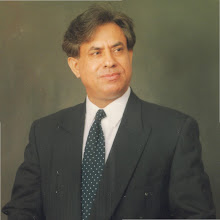

A Distinct Candle is Extinguished!
-
“I am announcing, with a heavy heart, the sudden demise of my beloved
father, Asif Javed Mir, due to heart failure on 18th December,2013. I
request to ever...
12 years ago

 Posts
Posts


