Mr. President, Pakistanis, and Friends:
Thank you so much for inviting me to speak at this forum. Honestly, I am flattered to address a wonderful audience hailing from a cultured Pakistani community. I am here to talk on the subject relevant to Independence Day of Pakistan. Kindly take my frank comments and objective analysis as coming from a concerned Pakistani and not as official statement or government policy.
Mr. President, Brothers and Sisters, I have the reason to believe that the Movement for Freedom of Pakistan was kindled by Haider Sultan of Mysore (you may recognize him as father of Tipu Sultan). Allama Muhammad Iqbal provided a new impetus to this Movement and a thought through vision was thus set. This vision was no different from what was ordained in Qur’an al-Karim (Surah 109 – Al-Kafirun).
The spirit that culminated the movement for freedom sought a separate homeland for Muslims where its citizens would have freedom to live a way of life according to Islam—i.e., freedom to work, freedom to organize; and freedom of analogous choices. Under the vibrant leadership of Quaid-e-Azam Muhammad Ali Jinnah, this freedom was eventually accomplished exactly 57 years before on Aug 14, 1947. This was no small achievement. This freedom was not given; it was taken and at a considerably high price. The ticket to freedom was purchased with the blood of our brothers, sisters, fathers and mothers. The Hindu and Sikh carnage of our Muslim youth turned out to be a dark part of freedom movement. We witnessed train loads of dead bodies arriving at Lahore Railway Station as an authorization for the price we paid for freedom. We cannot and must not forget this price.
I am proud to be a member of the nation that paid high price. Just the same, I feel guilty for failing to remember what was sacrificed; what was conceded. Consciously or unconsciously, nevertheless, we forgot the sky-scraping price paid for freedom; we forgot for we didn’t bother to recognize the role and responsibilities this freedom brought along. We failed to remember that the freedom had to be refreshed by the manure of our blood to keep its flame alive. We successfully but wrongly exercised our right to freedom for freedom from responsibility. We started pillaging our own country. Instead of giving our blood to sustain freedom, we came out to eat the vitals of nationhood. The educated elite left the country to benefit Europe and America and thus the selfish leadership was let out for robbing its own land.
The word 'freedom' means for me not a point of departure but a genuine point of arrival. The point of departure is defined by the word 'order.' Freedom cannot exist without the concept of order. We lost the order, stability, and harmony and thus transformed into a crowd of individuals engaged in a race for loot and serving personal interests.
Freedom is not choosing, Mr. President, Brothers and Sisters, that is merely the move that we make when all is already lost. Freedom is knowing and understanding and respecting things quite other than ourselves. By attempting to avoid the responsibility for our own behavior, we gave away our power to selfishness, narcissism, and smugness. In this way, we escaped from freedom. And most tyrannically we started believing that the vision enshrined by the Pakistan Movement was accomplished and our mission completed.
We were supposed to integrate the vision of Pakistan into our life, making it hard to put off or drop our highest priorities. Such focusing could provide us a framework for all parts of our life. Unfortunately, it could not happen and consequently today we fall short of spirits analogous to an independent nation.
The most important role of vision in our national life was that it could give focus to human energy. To enable everyone concerned with Pakistan to see more clearly what’s ahead of him or her. For this purpose, our leadership could convey a vision. Implicitly and explicitly, this is not done.
Imagine watching a slide show when the projector is out of focus. How would you feel if you have to watch blurred, vague, and indistinct images for an entire presentation? Today we face a similar situation in Pakistan. We are unaware of our future. People are expressing frustration, impatience, confusion, anger, and even nausea. Undoubtedly, the leaders with the fingers on focus button had the responsibility to focus the projector. They have utterly failed in their responsibilities. Thus without any direction and without a roadmap, Pakistan continues to lurch around, getting off course and ending up in places it never wanted to go to. Had Pakistan maintained a vision, its distractions would have been minimal and our national life would have been spent in a meaningful way. Thus it would have regained control over our life and no longer felt like wasting time.
Even after 57 years we have failed to learn to make our motivating vision important. This would have helped us in carrying out the goals with passion and energy; giving a focused meaning to a solid foundation to work from.
Mr. President and honorable Friends: Brain drain from Pakistan caused dangerous holes in political, bureaucratic and corporate leadership. They were nevertheless filled by selfish, corrupt and false leadership. Thus this corrupt lot steered Pakistan to the destination which we all witness today with confusion and loss of nerve.
Those Pakistanis who can afford, send their children to Europe and America for higher studies. It is unfortunate that such Pakistanis after completing their studies do not return to Pakistan. Since one in three Pakistani professionals will like to live outside Pakistan, Pakistani universities are actually training one third of their graduates for export to the developed nations. We are thus operating one third of Pakistani universities to satisfy the manpower needs of Great Britain and the United States. Stated differently, the Pakistani education budget is nothing but a supplement to the American or British education budgets. In essence, Pakistan is giving developmental assistance to the wealthier western nations, which makes the rich nations richer and the poor Pakistan poorer.
It is the best and brightest that can emigrate, leaving behind the weak and less imaginative. We cannot achieve long-term economic growth by exporting our human resource. In the new world order, people with knowledge drive economic growth. We talk a lot of poverty alleviation in Pakistan. But who is going to alleviate the poverty? Or the uncreative bureaucracy that created poverty? Hypothetically, the most talented should lead the people, create wealth and eradicate poverty and corruption. You are highly educated lot. Your country, your roots needed you. You should have gone back to Pakistan and played a role in the reconstruction of Pakistan. You should have applied what you have learned, practiced or observed here. Alas! It could not happen and Pakistan could not benefit from your rare skill and exceptional expertise.
In theory, overseas Pakistanis are morally obliged to return back home. In truth, it is unrealistic thinking that that a Pakistani professional will resign from his $60,000 a year job to accept a $3,000 a year job in Pakistan. A more meaningful question will be to ask: What measures can be taken to entice Pakistanis leaving abroad to return home and what can be done to discourage those professionals in Pakistan to remain in Pakistan?
The brain-drain seriously affects the quality and delivery of public and private services there are two obvious solutions (a) make it worthwhile for highly-trained professionals to stay and (b) replace them with competent locals at a rate as fast or faster than their departure brain train.
Another solution is to devise strategies of brain gain. These can take the development of a brain gain network. Pakistan is not effectively encouraging the use of its diaspora in contributing to development at home (for example, 80 per cent of recent foreign investment in the People's Republic of China came from overseas Chinese). The brain gain network can help in the promotion of joint research and teaching posts, the use of medical specialists in periodic return visits, short-term training assignments and even systematic professional and research collaboration on electronic networks. These could be effective ways of harnessing the skills of some of the distinguished scientists, medics, artists and educators with Pakistani origins living abroad.
With good employers, attractive working conditions, improved telecommunications and the entrepreneurial climate in India today, young professionals are moving back and strengthening the economic sector. Then IT professionals in India are quite often paid in foreign currency at international rates to prevent brain drain and hence exports of Indian software industry is now in the range of $10 billion.
Pardon me on going off track.
After the death of Quaid-e-Azam, we have allowed corruption to creep into our society as a way of life. Thus, we have become desensitized to corruption and our moral judgment is impaired. Even worse, at each step along the way, we eliminated Islamic injunctions from our lives and culture.
I feel highly embarrassed to pronounce that even after 57 years of independence we could not eradicate corruption. It is today deeply embedded in the political culture and poverty of Pakistan. Regulatory bodies are particularly vulnerable to corruption as they have the power to make key decisions on profit-making activities. Corrupt regulatory bodies are thus dangerously impeding economic development.
Prevalence of corruption in various political regimes has been the main cause of their downfall.
New attitudes, better financial systems, prosecution of the guilty, better management of affairs and real accountability to the people … this should be the agenda for change. In taking it forward, the leading role must obviously be taken by the people and Government. But tackling corruption effectively requires a real focus, coordinated action and shared responsibility. Everyone’s energies must be thrown behind this anti-corruption strategy. It is the key to a better future for the people of Pakistan.
Mr. President and Friends: Allow me to take your attention for a peep into ancient history. As in the experience of all other civilizations it can be with us if we do not recognize the principles for survival. If we failed to learn from history and recognize the future trends, we will eventually go back into darkness from whence we came, and we the people who got freedom 57 years before will perish from the earth.
If you retrace your thoughts back to where there were those old civilizations, some five or six thousand years ago, the Egyptians, you will find that they were very intelligent, highly advanced but through corruption, selfishness, prejudice and moral degradation they went into the debris of ancient history. We, in this advanced civilization, are representing similar predilections, can also follow the same destiny and go back into the dark age from whence we came.
Egyptian civilization has been forgotten. It went down, not only mentally, scientifically, intellectually, but also physically, to let us see and know that those who go down mentally and do not alter their ways also go down physically.
After the Independence, we lost our vision and subsequently transformed into one of the corrupt nations worldwide, all the nasty crimes once akin to the West now dominate our national life, and last but not the least each individual of Pakistan seems to be on the looting binge. Instead of contributing our role in nation building, we started pillaging our own land. When we are nurturing the same traits that caused extinction of Egyptian Civilization, my mind agitates to ask why then our destiny would be any different?
The societies that sustain physically, mentally, and otherwise are those which undergo a series of divergences in development, much like the branching of a tree. The dynamic people are those who are responsive to issues, essentially open, fast paced, balanced, and tend to survive and prosper on a fairly reliable basis. Problems come to them, but they usually manage to work them out.
The struggling society of Pakistan, contrarily, outdoes the people in narrow areas of endeavor from time to time, and becomes generally more retarded in overall development as time goes by.
Outwardly, we are a developing society. But like a muscular athlete with a terminal cancer, a disease is eating away at us from the inside. A great nation cannot be destroyed from the outside until it falls first from the inside.
No matter how well we might arm ourselves against enemies outside our borders, the greatest enemy is none else but us, who place destructive devices inside our destructive minds, causing us to morally implode, like an imploding building.
Ever since independence in 1947, we have experienced a complete abandonment of our sense of good and evil. The true crisis of our time has nothing to do with monetary troubles, unemployment, or terrorism. The true crisis has to do with the fact that we have lost our way.
If you drop a frog into a pot of boiling water, the frog will immediately jump out. But if you place the frog in a pot of lukewarm water and slowly turn up the heat, the relaxed frog will just swim around, growing accustomed to the increasing warmth until it eventually boils to death. This is what is happening to us and our cultural decay. It is a gradual process that slowly dulls our senses until what was once seen as unacceptable somehow becomes acceptable.
What will remain of civilization and history if the accumulated influence of Islam, both direct and indirect, is eradicated from literature, art, practical dealings, moral standards, and creativeness in the different activities of mind and spirit?
Consequently, a flood of immorality, corruption and violence has entered into our national life, and we have unfortunately been recognized as a culture of death from the womb to the streets. Many of our young people have no concept of the true spirit of Islam; and many are tragically engaged in dying or killing innocents. A sense of hopelessness prevails, a feeling of fear surrounds.
We have forgotten our true nature, divinity, because 'scientifically' it cannot be proved! We are ignorant of true purpose of life. Values like solidarity, natural love, forbearance, compassion, generosity, and altruism do not find any place independent of an 'individual'.
The culture shows signs of degeneration into lawlessness, disease, and want on one hand, and affluence and sense gratification of wanton degree on the other. With this decline in cultural values, ethical values are also eroded. Not one particular field is afflicted with this 'virus of corruption'; all departments of human interaction show the same trend. It is difficult to find an isolated island of purity in the sea of corruption all around.
Ethics is the reflection of cultural health of the society. In course of evolution of human societies, man creates progressive cultural and moral ethos. But then a stage comes when cultural growth slows down for want of fresh ideas. Consequently ethics also remains a mere shadow of its own previous glory. Now it is in search of fresh inputs to spring to new life again. Therefore, when matter is worshiped as supreme and privileges are sought after, ethical decline is not a surprise. The remedy lies in adding spiritual dimension to existing culture and in course evolving a new moral and ethical code for coming generations. Time is still not gone. We can learn lessons from Egyptian civilization or else face extinction. Choice is only ours.
Thank you for listening.
God bless you all.
God bless Pakistan
Asif J. Mir, Organizational Transformation


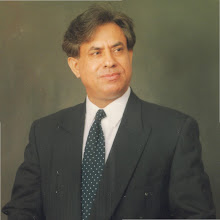

A Distinct Candle is Extinguished!
-
“I am announcing, with a heavy heart, the sudden demise of my beloved
father, Asif Javed Mir, due to heart failure on 18th December,2013. I
request to ever...
12 years ago

 Posts
Posts


