Ever since independence technology has sneaked in tardily. Paradoxically, these years have produced equally strident laments concerning the state to which Pakistan’s education has sunk. The educational foundations of our society are presently being eroded by a rising tide of mediocrity that threatens our very future as a nation and a people.
When information technology was approaching in the sixties the US changed the school curricula for preparing students for the future. Contrarily we continue to turn our eye from the need to adopt new technologies and consequently our students are not being prepared (IT students included) to live in a competitive world.
We have managed to survive without adoption of IT for forty years. It will be impossible to continue to exist even for a day if we failed to adopt the approaching technologies. For instance Nanotechnology—examining the world at a millionth of meter and utilizing the ability to manipulate our universe at a molecular or atomic perspective—has united scientists across developed world in the belief that the worlds of medicine, computers, biotechnologies and eventually all manufacturing will never be approached in the same way again. We can’t afford to respond as laggards and follow the same doom which ancient civilizations faced. They perished for resistance to new technologies.
In ancient Greece then, all of the energy sources in use today, with the exception of nuclear power and hydroelectric power (both used exclusively to produce electricity) were known, available, and in limited use. Why then did it take so many centuries for energy sources and technology to come together to produce the Industrial Revolution?
From ancient Greece into the early Renaissance technological development was not only frowned upon, it was downright discouraged. People with money did not invest in it. It was socially unacceptable for the elite to involve themselves in what they considered a degrading activity.
The Greek philosophers, for all of their delving into how the world was made up and how things worked, had a strong aversion to the development of technology. They called it banausikon, meaning, fit for mechanics. It was considered a filthy business beneath the dignity of any intelligent, thinking person. Aristotle held that industries that earned wages degraded the mind and were unworthy of the free man. He would not stoop so low as to attempt to verify by measured observation his reasoning concerning physics or dynamics. As a result, some bad science went unchallenged for almost 2,000 years.
The Museum and Library at Alexandria, established in 290 BC by the rulers of Egypt, was a research facility that attracted scientists from around the known world. Researchers would use valves, expanding gases, solar thermal power, cams, screws, pulleys, levers, springs, siphons, and cogs—the basics for an industrial revolution. They developed double-action pumps and a compressed air cannon. It was there that Hero demonstrated a steam reaction turbine in 60 AD. The Library at Alexandria could have been an ancient model for Silicon Valley, but the research did not lead to improved manufacturing processes, better machines for industry or agriculture, or even for increasing wealth. Rather it was used to amuse royalty or to amaze worshipers in temples.
A valid argument can be made that metallurgy, manufacturing processes, and transportation facilities were too primitive to allow for exploitation of energy and technology at that time. But, absent the social barrier to technological development that existed, it is likely that the great minds, the available wealth, and the power concentrated in the likes of Alexander the Great, and the Roman Emperors could have laid the groundwork for a much earlier development and diffusion of technology.
We are accustomed to resist technological change with full force. We not only refuse to recognize it; we close our eyes to evade it. The attitude that we demonstrate confirms our nasty characterization as a nation of laggards.
Embracing technology is a laudable objective for which our society must aspire. It should provide a classic demonstration of the principles of the Technology Adoption Lifecycle and attempt to explain the pros and cons of investing in new technology. It must transform itself as innovators, early adopters, and not as laggards on a technology adoption timeline.
We should inculcate education of technology at every level of learning. If we claim to know more about how people learn, if we have better tools for facilitating learning, why do so many studies of technology in education show no significant difference from traditional methods? Why are we producing graduates less able to cope with the issues facing them?
Making matters worse, the criteria for success have changed. Our institutions were designed not for an industrial society. Now we've entered the Information Age. Increasingly, even blue-collar jobs require critical thinking, rather than monotonous task performance. To meet these demands, our graduates need different competencies than we typically provide. Intuitively, one would expect technology to be a powerful tool for meeting these new requirements.
We are entering a world in which jobs are requiring technological competency--a world in which they must continue to update their occupational and technological skills in order to be successful. We must enable them to become technologically competent. We must take advantage of the capacity of technology to enhance our traditional classroom presentations and to engage our students in active learning.
Pakistan’s decision-makers must focus on new challenges and issues instead of waiting for emergencies to react. They need to focus more on policy than management issues. They need to be knowledgeable about what rest of the world is doing to achieve change. They should know that change and implementing technology often go hand in hand. The key to success in both is a thorough, inclusive planning process. The disregard of new technologies by ancient civilizations offers us a choice: to embrace new technologies or perish.(www.asifjmir.com)


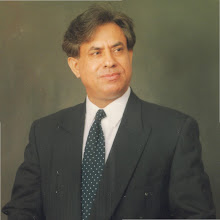

A Distinct Candle is Extinguished!
-
“I am announcing, with a heavy heart, the sudden demise of my beloved
father, Asif Javed Mir, due to heart failure on 18th December,2013. I
request to ever...
12 years ago

 Posts
Posts


